

February 27th update from the AIG:
Temporary Changes to International Calling on Ascension Island
Ascension Island Mobile (AIM) has recently launched mobile phone services on Ascension Island. The priority during the network launch has been to ensure that the local island network is up-and-running in advance of Sure South Atlantic exiting on 28 February 2026. There will be some disruption to international calling from Sunday, 1 March. During the transition period, residents in St Helena are advised that residents in Ascension Island may not be able to make or receive international telephone calls or send international SMS (text messages) using landline or mobile voice services.
Telecoms operators internationally can route phone calls to Ascension Island. AIM recognises the importance of maintaining affordable routes of communication and is actively working with Sure South Atlantic and other global partners to put in place the necessary arrangements as soon as possible.
As international dialling arrangements may vary by country and provider, callers are advised to contact the intended recipient in advance to confirm the correct number to dial from outside Ascension Island.
To stay connected, residents are encouraged to use Voice over Internet Protocol (VoIP) and social media messaging services as temporary alternative means of communication. Applications such as WhatsApp and Facebook Messenger should continue to function and can be used for voice calls, video calls and messaging, subject to internet availability.
This post examines the latest milestone in Ascension Island’s telecommunications story, set against the accelerating global adoption of Starlink and its relevance for the Falkland Islands. If you are new to this unfolding saga, you may wish to begin with my two earlier OpenFalklands posts, which anticipated how similar dynamics could emerge in the Falklands.
May 2024: An update to the use of Starlink in the Falkland Islands; Part One, the Ascension Island story.
Aug 2025: Sure’s Ascension Standoff Hints at Falklands Strategy
The original 18th December 2025 Ascension Island Government (AIS) press release can be read here.
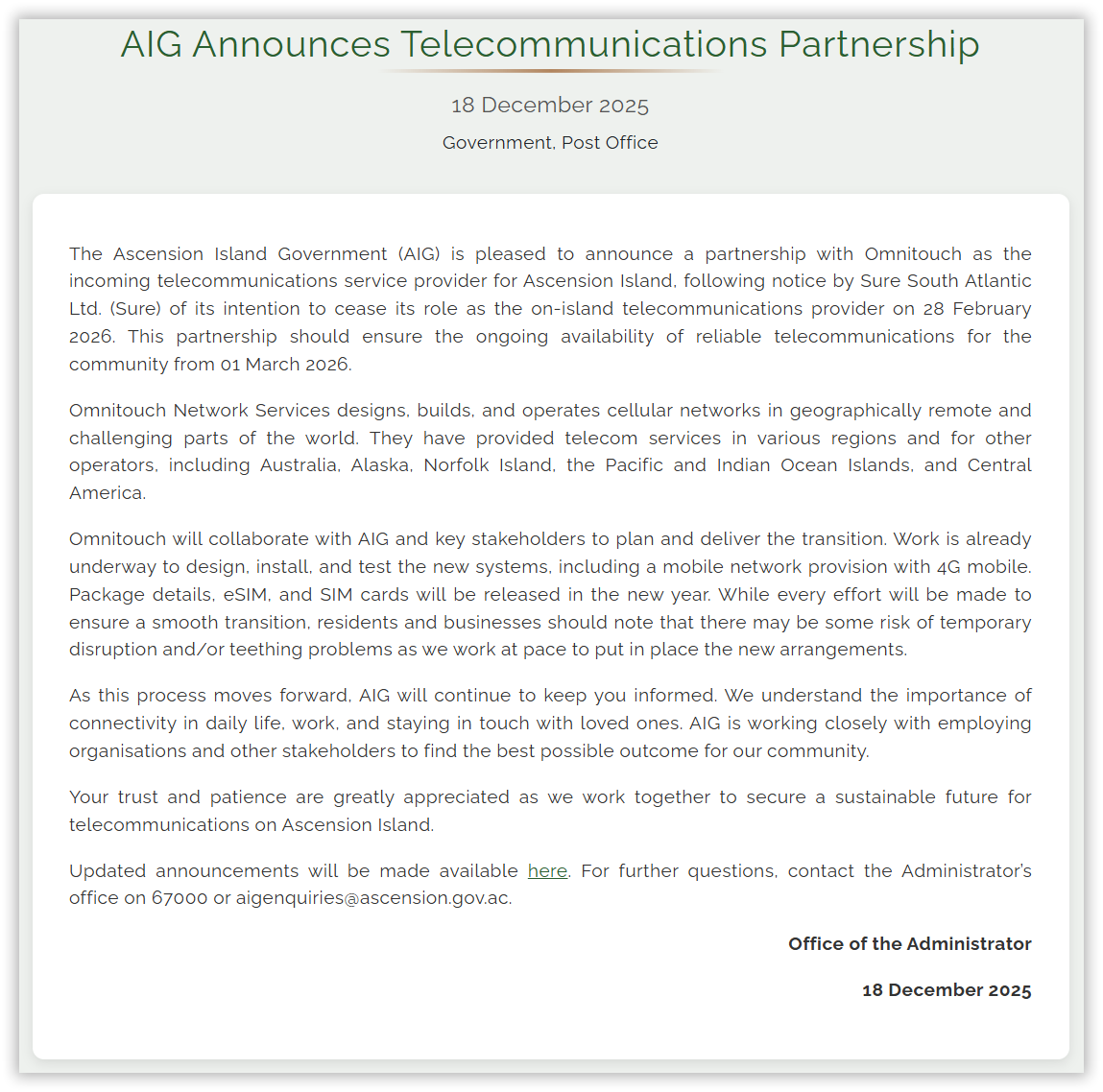
The recent announcement by the Ascension Island Government (AIG) that it will replace Sure South Atlantic (Sure SA) as its telecommunications provider from March 2026 is, on the surface, a straightforward continuity decision. Sure SA gave notice of withdrawal, and Ascension has moved quickly to secure an alternative operator with Omnitouch Network Service. However, read in the context of earlier developments already discussed on OpenFalklands, the announcement carries a broader significance for the Falkland Islands that goes beyond a simple change of supplier.
Ascension’s telecoms story has already featured prominently in discussions around Starlink, monopoly licensing, and regulatory leverage. Previous analysis on OpenFalklands explored how Starlink’s appearance in Ascension exposed tensions inherent in single-provider models, and how Sure’s subsequent standoff with AIG could plausibly be interpreted as part of a broader negotiating strategy rather than an isolated local dispute. Seen through that lens, Sure’s eventual withdrawal from Ascension does not contradict earlier arguments; instead, it reinforces the idea that telecommunications in small territories are increasingly shaped by strategic positioning as much as by pure economics.
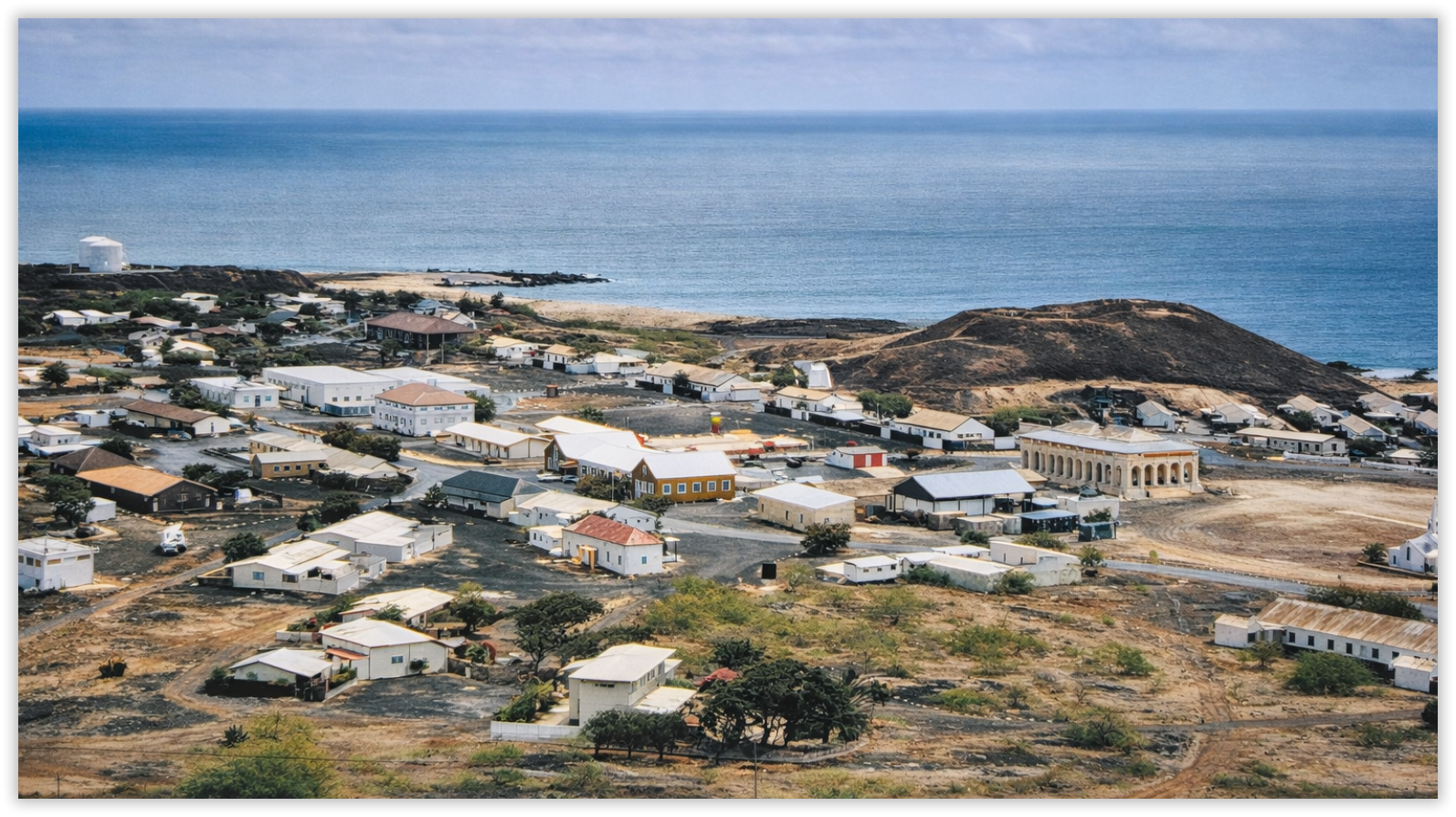
One takeaway from Ascension’s latest announcement is not simply that Sure SA is leaving the island but that an alternative has been put in place quickly and credibly. Omnitouch is a specialist operator whose business model is explicitly built around very small, remote, and logistically complex markets. Those characteristics closely match conditions in the Falkland Islands. Ascension therefore demonstrates that the argument that “there is no realistic alternative provider” is weaker than it once appeared, even if any transition would inevitably be complex and challenging.
A further lesson from Ascension is that provider exit risk is no longer theoretical. For years, it has often been assumed that the monopoly telecoms provider might threaten withdrawal but would ultimately remain because it was too embedded to leave. Ascension shows that this assumption no longer holds. Sure’s withdrawal demonstrates that exit is now a real possibility, and FIG must plan for it. The key lesson is not that withdrawal is inevitable, but that assuming it will never happen is no longer a safe basis for policy.
Another lesson from Ascension is that public expectations around connectivity have permanently shifted. Once people experience modern services, their baseline expectations reset to global norms rather than local history. These expectations do not reverse. Even where monopoly arrangements persist, as in the Falklands, users know alternatives exist. For the Falklands, this means that tolerance for slow improvement or limited services is likely to continue declining.
Although Ascension’s telecommunications needs differ significantly from those of the Falkland Islands, the announcement also subtly underscores a shift away from traditional, vertically integrated monopoly assumptions. Ascension’s new arrangements emphasise mobile connectivity, rapid deployment, and modern network design. This aligns with the broader technological pressures already discussed in relation to the Falklands, where Starlink has challenged legacy models based on scarcity and monopoly control. The implication is not that mobile networks replace all other infrastructure, but that telecoms planning increasingly starts from a data-first, mobile-centric baseline.
Government posture is another important parallel. The AIG has been explicit about managing risk, coordinating stakeholders, and acknowledging the likelihood of short-term disruption. That approach mirrors a growing recognition, also evident in Falklands debates, that telecommunications are not just another commercial service but critical national infrastructure. This framing strengthens the case for a more active public-sector role, whether in regulation, procurement, infrastructure ownership, or acting as an anchor customer to shape outcomes.
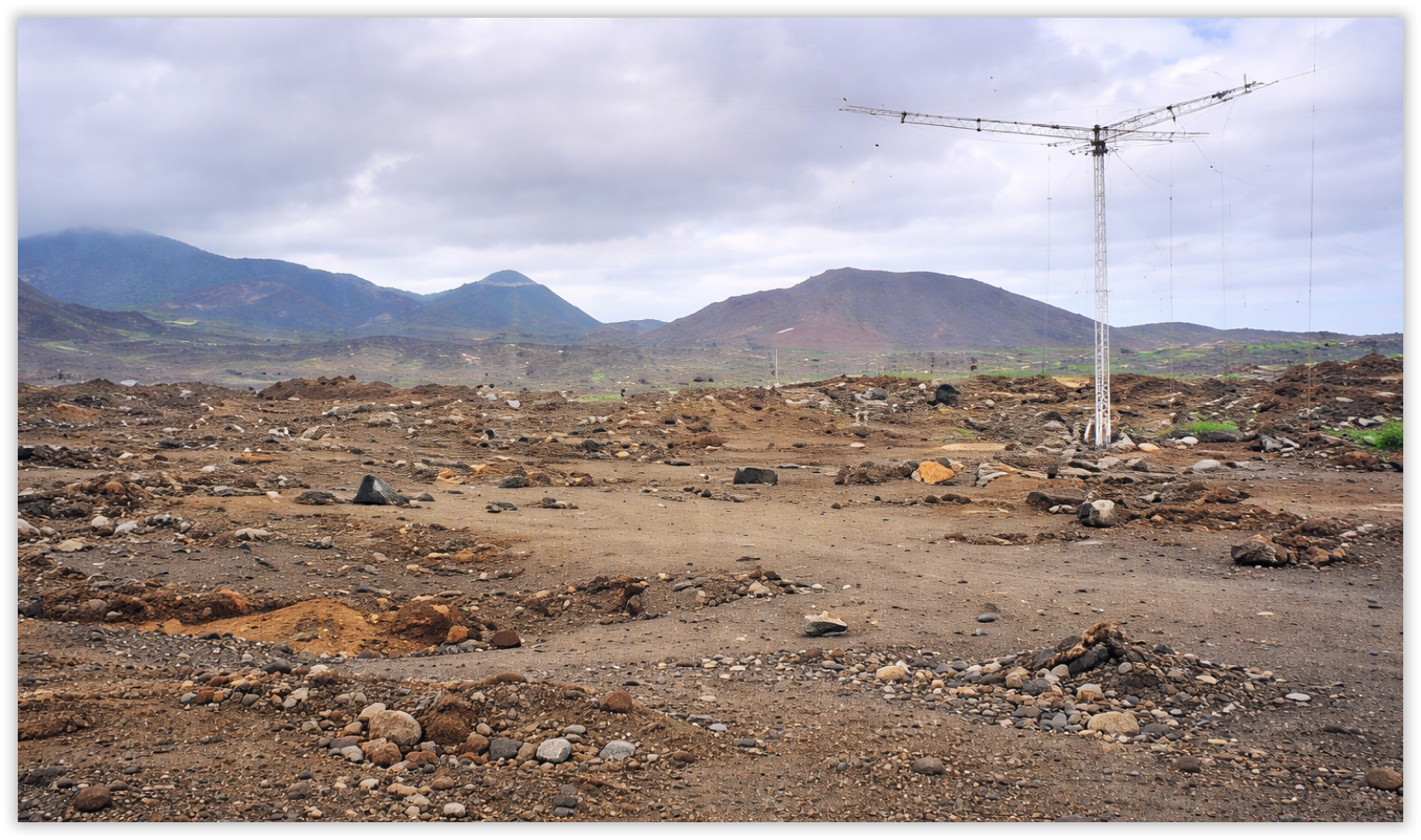
Taken together with earlier analysis on Starlink and Sure SA’s extreme strategic behaviour, Ascension’s latest announcement does not fundamentally alter the direction of the argument on OpenFalklands. Instead, it adds weight. It shows that withdrawal threats can become reality, that governments can respond by securing alternative providers, and that specialist operators are willing to step into markets once considered too small or too remote. For the Falkland Islands, this makes a discussion of post-monopoly telecommunications less hypothetical and more grounded in the observable regional experience in Ascension and, not to forget, St Helena.

About Omnitouch

Omnitouch Network Services is an Australian-registered company specialising in designing, building, and operating cellular networks, particularly in remote and geographically challenging areas.
Omnitouch’s expertise centres on Mobile Network as a Service (MNaaS): a turnkey solution in which they deliver and manage all core and radio network components, allowing operators to focus on customer services rather than infrastructure. This model supports rapid deployment, flexible scaling, and managed operations across mobile and fixed wireless technologies.
Their global footprint includes work in islands and rural regions, such as Norfolk Island, where they helped establish a modern 4G network, and Alaska’s rugged territories, demonstrating their ability to deliver reliable connectivity to places often overlooked by larger vendors.
Chris Gare, OpenFalklands, January 2026, copyright OpenFalklands
Will you make an update on the problems that AIM are having currently? Apparently no-one can call landlines on Ascension, and mobiles aren’t working properly either.
We headed up to a remote high point on the island to test the new 4G service from Ascension Island Mobile — and the results were really encouraging.
Even in a really isolated spot away from the main settlements, we was getting over 2 Mbps download speed, and YouTube loaded and streamed without any issues at all. 👍
What makes this even more impressive is that AIM is a brand new network, replacing the old SURE service. Considering it’s still in its Beta testing stage, this is a very promising start. This is an excellent supplement to Starlink for Roaming around the Island; giving connectivitly around the whole island. AIM will also be offering a Home Internet Package and Landline Service!
It is great to see connectivity improving across the island after so many years of the same old service — which now provides full island coverage including the more remote areas.
Packages look reasonably priced, with options of unlimited calls and texts, supplemented with a fair bit of Mobile Data.
Excited to see how performance develops as testing continues over the next few weeks.
Dont forget to signup here:
https://aimobile.ac
The service is currently FREE until the 31st March 2025 which includes unlimited Data, Calls and Text!
Overall this is a very good service!