
PDF version of the six posts – The case for a Telecommunications Select Committee
The headline numbers to remember for busy readers:

How the Compensation Agreement Came About
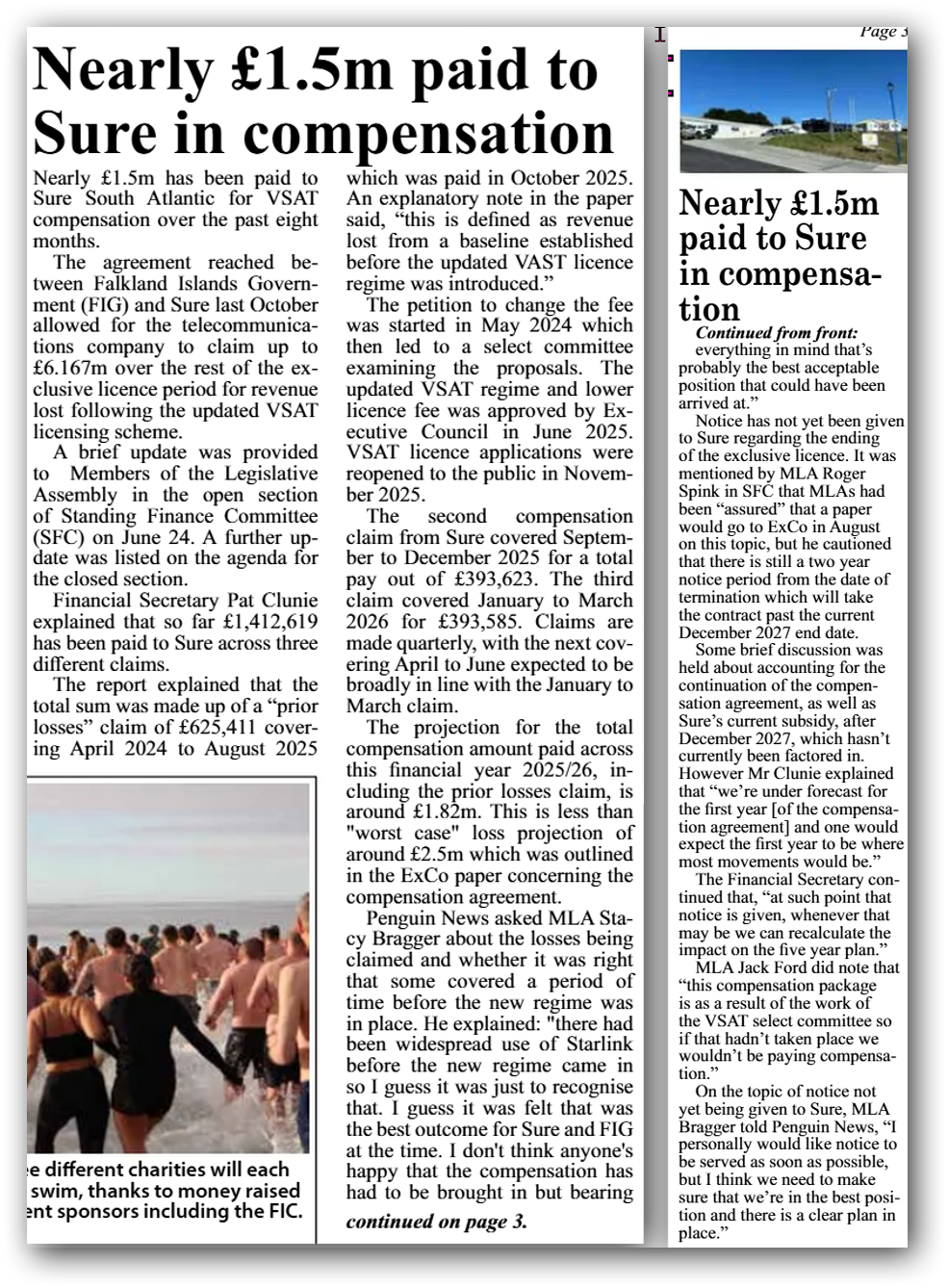
The compensation agreement was negotiated after Sure threatened legal action in response to the October 2025 ExCo paper approving the revised VSAT (Starlink) licensing policy. According to the ExCo paper, Sure argued that the changes would harm its commercial viability and breach its legitimate expectations under the exclusive licence. Rather than risk a lengthy and costly judicial review, FIG negotiated a commercial settlement based on compensation. The ExCo paper noted that legal proceedings could have significantly delayed the implementation of the revised VSAT policy.
The resulting agreement allows Sure to claim compensation for demonstrated broadband revenue losses relative to a baseline established before the widespread adoption of Starlink. Claims are submitted quarterly and follow a tiered formula intended to incentivise Sure to continue operations in the islands.
The ExCo paper authorising the agreement stated it was an appropriate use of public funds, given the essential nature of Sure’s services and the need to maintain universal service for the rest of the licence period. While this justification was valid at the time, the timetable has since changed.
The Maximum Compensation Liability
The compensation agreement authorised a maximum liability of £6.166 million, based on the assumption that Sure’s exclusive licence would end at the earliest opportunity in December 2027, following notice in January 2026.
The authorised amounts were:
- 2025/26: £2,495,040 (including back payments)
- 2026/27: £2,447,753
- 2027/28: £1,223,877 (to December 2027)
What the Current Claim Rate Means in Practice
It has been noted that because compensation claims have been lower than expected, there is significant headroom within the authorised £6.166 million provision.
At current claim rates, about £2.4 million of the authorised provision would remain after payments through December 2027. This suggests the existing provision could cover compensation for roughly 18 months beyond December 2027, assuming claim rates stay consistent.
However, this conclusion should be approached with caution for two reasons.
First, if Sure’s future claims rise toward the maximum rate assumed in the agreement, the available headroom would be significantly reduced, potentially covering only about five additional months beyond December 2027. Notice has already been delayed by six months.
Second, both the original ExCo paper and the recent Standing Finance Committee paper state that any compensation beyond December 2027 – as is the case, as notice was not given in January 2026 – would require new negotiations. It is unclear whether any underspend within the existing £6.166 million provision could be used to extend the licence period. Until FIG clarifies this, the apparent headroom should be viewed cautiously.
Video credit: FITV
The Continuing Broadband Capacity Payments
The VSAT compensation agreement is not FIG’s only financial commitment to Sure during this period. Since 2019, FIG has paid Sure approximately £1,042,000 per year under successive broadband obligation agreements. These payments began with the 2019 three-year agreement and continue under the 2022 five-year agreement, which runs until the current exclusive licence ends in December 2027. Will this be extended after December 2027, or will satellite capacity need to be reduced without a subsidy?
Although these are separate arrangements, the VSAT compensation of £393,000 per quarter and the broadband capacity obligation of £260,000 per quarter together total an estimated £653,000 per quarter, or about £2.6 million annually, paid to Sure South Atlantic while the exclusive licence remains in effect.
What the Numbers Tell Us
Budget headroom does not make these payments cost-free. Each quarter that passes without notice being served is associated with a further compensation payment of about £393,000, delaying the earliest possible end of these arrangements. Notice could have been given as of January 2026, but it has not been, and a fourth quarterly claim is now expected for the April to June 2026 period.
At current payment rates, the existing compensation provision appears sufficient to cover payments through December 2027 and possibly beyond. However, this apparent headroom should not be seen as a reason to delay action.
The original ExCo paper anticipated that, if Sure’s exclusive licence were extended beyond December 2027, additional compensation payments could become due. More recently, the Standing Finance Committee confirmed that any such extension would require fresh negotiations with Sure and that no budget assumptions have yet been made for that period. Whether any apparent underspend within the existing £6.166 million provision could, therefore, be automatically used to fund an extended period of exclusivity remains unclear.
The ExCo paper on telecommunications, expected in August, should address both the issue of serving notice on Sure and the long-term structure of telecommunications in the Falkland Islands. Regardless of the model chosen, the timing of this decision now carries clear and measurable financial consequences. If new public information emerges that changes this analysis, I will provide an update.
Chris Gare, OpenFalklands, July 2026, copyright OpenFalklands
That’s a significant amount to consider, especially when you think about the ongoing impact of these kinds of licensing agreements.