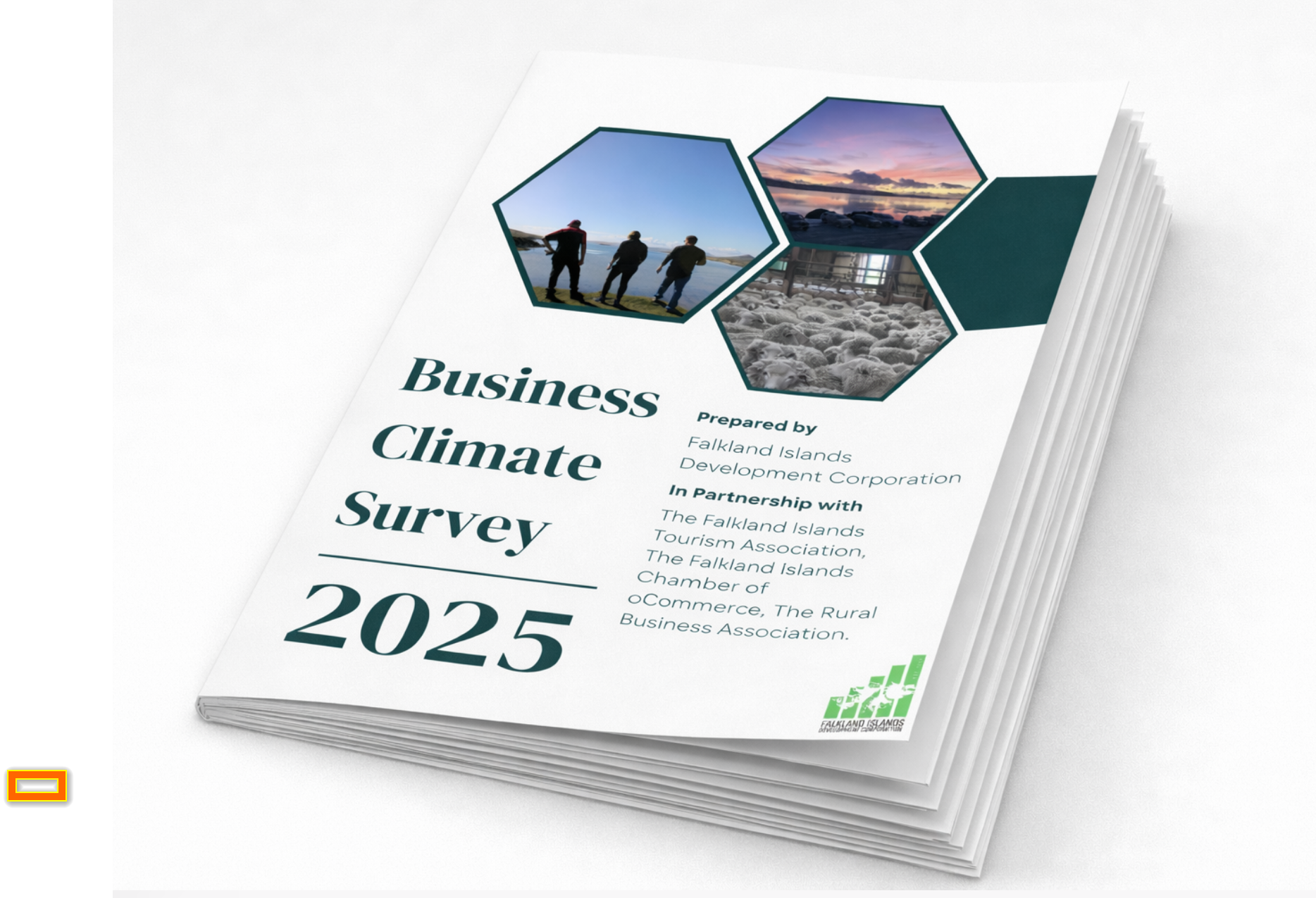
On December 19th 2025, the Falkland Islands Development Corporation (FIDC) published its 2025 Business Climate Survey with the statement:
“FIDC is pleased to release its latest edition of the Business Climate Survey, a biennial survey conducted with its business association partners, Falkland Islands Chamber of Commerce, Falkland Islands Tourism Association, and Rural Business Association.”
You can download the 2025 Business Climate Survey Report here. This OpenFalklands post will focus on the survey’s findings on telecommunications in the Falkland Islands.
When the survey was conducted between 31 March and 1 May 2025, it captured business opinion at a moment of transition in the Islands’ telecommunications landscape. Since then, developments around Starlink availability and uptake have begun to change the practical connectivity options for some business users. As a result, the survey should be read as a snapshot of business sentiment before those changes fully materialised in December 2025.
That said, the findings remain highly relevant. They reflect the depth, persistence, and scale of dissatisfaction with the Islands’ telecommunications that emerged after many years of limited choice, constrained capacity, and high costs, and they provide essential context for understanding why demand for alternative connectivity solutions has been so strong.
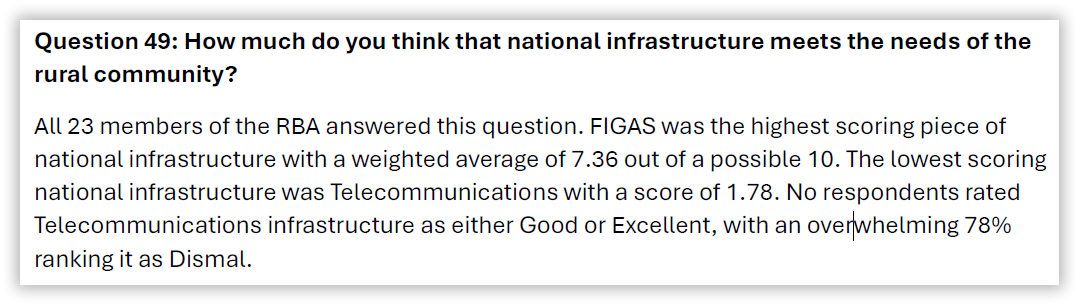
Telecommunications is the only barrier that cuts across every theme raised by businesses in the survey. It appears as:
- A growth barrier
- An innovation barrier
- A rural infrastructure failure
- A tourism reputational issue
- A Stanley productivity constraint
- A cost-of-doing-business issue
- A constraint on diversification
No other issue in the survey has that reach.
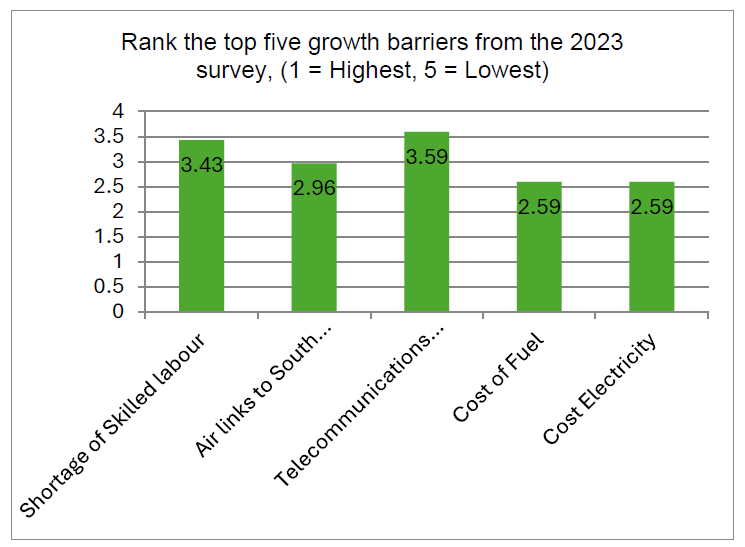
The survey once again places telecommunications at the centre of the Islands’ economic challenges. For the fourth survey cycle in a row, businesses have identified poor connectivity as a significant barrier to growth and innovation. This year, however, the message is more stark than ever: telecommunications bandwidth speed and quality are ranked as the most significant constraints on business development across the Falkland Islands.
Fully 44% of respondents identified telecommunications bandwidth as a barrier to growth, placing it above fuel costs, electricity prices, labour shortages and transport links. This is not a new concern. Telecommunications has featured in the top five barriers since at least 2018, ranked first in 2021, third in 2023, and now back to first place in 2025. The consistency of this result strongly suggests a structural problem rather than a temporary one. The same constraint is blocking both today’s and tomorrow’s business.
What is particularly striking in the 2025 results is the breadth of businesses affected. Telecommunications is not confined to one sector or business type. Twelve primary sectors selected bandwidth speed and quality as a growth constraint, including tourism, transport, finance, energy-related services and communications itself. In several sectors, every single responding business identified telecommunications as a barrier. This underlines that connectivity is now foundational infrastructure, not an optional enhancement.
The issue is also not limited to Camp businesses. While connectivity challenges in Camp are well known, the survey shows that a majority of businesses citing telecommunications problems are based in Stanley. This matters because Stanley-based companies tend to be more diversified, more digitally dependent, and more engaged with off-island markets. When these firms struggle with bandwidth, the problem is systemic and economy-wide.
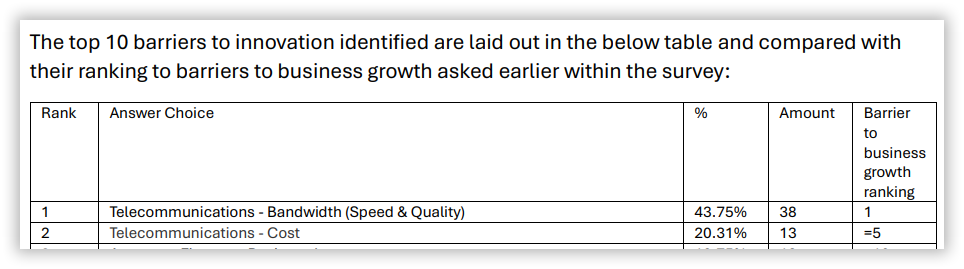
Cost compounds the issue. Telecommunications pricing was ranked jointly fifth as a barrier to growth, while package size also featured among the constraints identified by businesses. Taken together, businesses are signalling a three-part problem: internet connections are too slow or unreliable, too expensive, and too inflexible to support growth. Improving just one of these elements without addressing the others is unlikely to resolve the broader issue.
The telecommunications constraint also helps explain a broader contradiction in the survey results. An overwhelming majority of businesses describe themselves as innovative and say innovation is essential to their success. Yet business performance and economic confidence remain below pre-2022 levels. Digital tools, cloud services, online marketing, remote collaboration and data-intensive operations all rely on robust connectivity. Without it, the innovation potential is constrained before it can be converted into productivity or growth.
From a strategic perspective, the survey makes an implicit yet powerful argument: telecommunications is now a binding constraint on the Falkland Islands’ economy. It affects diversification, competitiveness, service quality and resilience. Unlike fuel prices or external transport links, it is also an area where local policy, regulation and investment choices can make a decisive difference.
The survey does not simply highlight dissatisfaction. It reflects a growing gap between how Falkland Islands businesses need to operate in a modern economy and the digital infrastructure currently available to them. If this gap remains unaddressed, it risks locking the Islands into lower-growth business models and weakening long-term economic resilience.
Starlink’s legal arrival in the Falkland Islands in November 2025 has unquestionably changed what is technically possible for some businesses, particularly in terms of raw bandwidth and latency. For many households and businesses, it offers immediate relief from long-standing capacity constraints and introduces long-missing competition into a closed market. However, its use is limited to internal staff and, under current regulatory arrangements, cannot be used for customer interactions, meaning it cannot be seen as a panacea for businesses’ broadband challenges.
However, Starlink does not resolve every issue highlighted by the survey. It does not replace the need for resilient, affordable, well-regulated core telecommunications infrastructure; it does not address questions of redundancy, national resilience, or long-term strategic control; and it is not equally accessible to all users due to cost, regulatory conditions, or practical limitations.
“The cost of providing guests with free unlimited wifi under the current system is extremely prohibitive and the selling of wifi cards is an embarrassment and a really bad advert for our country as a tourist destination.”
“We are never more than 60% fully booked because the amount of land based tourists are limited… The cost of providing guests with free unlimited wifi under the current system is extremely prohibitive.”
Starlink should be understood as a powerful new option, not a comprehensive solution. The survey’s findings, therefore, remain relevant: they explain why demand for alternatives has been so strong and underscore the continuing need for a coherent, transparent, and future-focused telecommunications strategy for the Falkland Islands.
Chris Gare, OpenFalklands January 2026, copyright OpenFalklands