To avoid any confusion at the outset, the CMC report has NOT been made public and is unlikely to be released by FIG any time soon, but it will go to EXCO in the near future. This post instead draws on and seeks to explain the high-level outcomes outlined in the case study published by Cambridge Management Consulting in March 2026. |
This post is the last in the current series. Recent OpenFalklands posts have discussed the Chris Doyle 2006 telecommunications report, the 2016 Cartesian telecommunications report, the 2017 Communications Ordinance, and the changes to the Falklands telecommunications landscape over the last decade.
Phase 1 report
In early 2025, the Falkland Islands Government (FIG) commissioned a telecommunications study in preparation for the expiry of Sure’s exclusive telecommunications licence on 31 December 2027. Phase 1 of the study was undertaken by Cambridge Management Consulting (CMC). CMC publicly reviewed its views in March 2025 at Stanley Town Hall, although no full public version of the report has been released. Download the full presentation PDF file here.
Phase 2 report
Phase 2 of CMC’s report was initiated in September 2025 with the Preliminary Market Engagement (PME) process. CMC’s Phase 2 project was completed in early 2026, and the report was forwarded to FIG, but the full version is likely to remain confidential and will probably never be released to the public.
In early 2026, CMC also published a Falkland Islands case study on its website, outlining the study’s high-level outcomes. “Building the case for Enhanced Connectivity” is also available on the CMC website.
CMC stated that by the end of Phase 2, the FIG should have received five key outcomes. These outcomes provide a useful framework for understanding the scope of the work undertaken and the considerations likely to inform future telecommunications policy in the Islands.
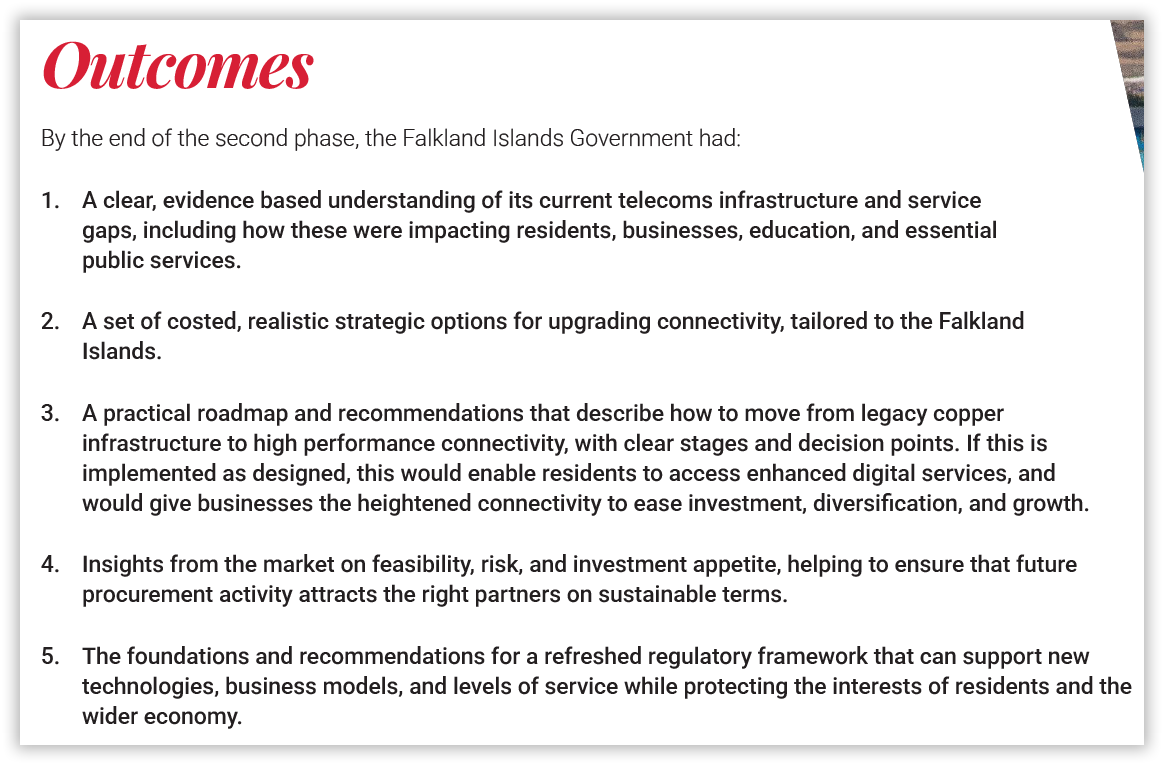
As the CMC report is not available to Falklands consumers and businesses, the sections below are NOT intended to reflect its specific findings. Instead, they draw on publicly available information, industry practice, and the historical context of telecommunications in the Falkland Islands to explain what such outcomes typically encompass. They should therefore be read as an explanatory guide to understanding the scope and implications of the stated outcomes, rather than as definitive accounts of CMC’s recommendations.
1. An Evidence-Based Understanding of Infrastructure and Service Gaps
CMC states that, with this report, FIG now has a clear, evidence-based understanding of current Falklands telecommunications infrastructure and service gaps, including their impact on residents, businesses, education, and public services.
In practice, this type of outcome typically involves a detailed assessment of existing networks across fixed, mobile, and international connectivity layers. It should normally include analysis of infrastructure performance, coverage, capacity constraints, and resilience, as well as differences in service quality between Stanley and Camp.
It should also encompass demand-side analysis, examining how different user groups rely on connectivity and where limitations have the greatest social and economic impact. Such an evidence base provides a critical foundation for decision-making, ensuring that future policy and investment are grounded in measured need rather than assumption.
2. Costed, Realistic Strategic Options
CMC also state that FIG now has a set of costed, realistic strategic options tailored to the Falkland Islands.
This typically means that a range of possible delivery models has been developed and tested against both technical feasibility and financial viability. These options might include different approaches to market structure, infrastructure ownership, and service delivery, as well as varying levels of public- and private-sector involvement. This should include options such as nationalisation, public/private initiatives, and even the continuation of exclusivity with the current provider.
Costing is a key component, as it allows decision-makers to understand not only up-front capital investment requirements (CAPEX) but also ongoing operational implications (OPEX) and long-term affordability. The emphasis on realism suggests that options have been filtered to reflect local constraints, including market size, geography, and likely investor appetite, ensuring that proposals are deliverable rather than purely aspirational.
3. A Practical Roadmap for Moving Beyond Legacy Infrastructure
CMC would highlight a practical roadmap for transitioning from legacy copper infrastructure and 4G to higher-performance connectivity, with defined stages and decision points. OpenFalklands has already looked at what telecommunications infrastructure needs upgrading in Camp and Stanley.
A roadmap of this kind generally sets out how change can be implemented over time rather than through a single transformation. It should typically include sequencing of key activities such as policy decisions, procurement processes, regulatory adjustments, infrastructure deployment, and customer migration.
The inclusion of decision points suggests a structured approach to managing risk, where progress is reviewed at key stages before committing to subsequent phases. This helps balance ambition with practicality, particularly in environments where large-scale infrastructure investment must be carefully managed.
Of course, such a roadmap would include a recommendation to give notice to the incumbent telecommunications provider. The 2017 Ordinance provides that “[The licence] shall remain in force unless and until the Regulator gives at least two years’ written notice of termination.” As no such notice has been given to the provider, to my knowledge as of April 2026, a minimum extension of the exclusive licence in 2028 of six months would be necessary.
4. Market Insights on Feasibility and Investment Appetite
The Preliminary Market Engagement process is reported to have provided insight into feasibility, delivery risks, and investment appetite by other telecommunications operators. What has recently occurred in Ascension might provide some guidance about this.
This form of engagement is designed to test proposals against real-world market conditions by gathering feedback from potential suppliers and investors. It typically explores the level of interest, viable commercial models, and the risks providers would be willing to accept. It is likely that such discussions would have been broadly positive.
Understanding investment appetite is particularly important in small or remote markets, where commercial returns may be uncertain. The findings from this process help shape procurement strategies and ensure that any proposed model aligns with what a possible new provider is realistically able and willing to deliver.
The PME process reflects a deliberate shift towards incorporating direct market input into policy development, ensuring that any proposed model or strategy aligns with what suppliers are realistically willing and able to deliver.
5. Foundations for a Refreshed Regulatory Framework
Finally, CMC states that FIG now has the foundations for a refreshed regulatory framework that can support new technologies and business models while protecting residents and the wider economy.
As telecommunications systems evolve, regulation must also adapt to accommodate new technologies and more complex market dynamics. At the same time, it must continue to safeguard consumers, ensure fair competition, and support broader economic objectives. Establishing these foundations is therefore essential to enabling any wider reform of the sector.
Certainly, it would seem that a considerable amount of work is needed to bring the 2017 Communications Ordinance and its 2019 Amendments into a suitable state for use over the next decade.

Interpreting the Whole
Taken together, these five outcomes point to a comprehensive scope of work, encompassing infrastructure assessment, strategic option development, market engagement, and regulatory considerations. Rather than focusing on incremental change, they should reflect the key components typically required to support more fundamental telecommunications reform.
The overall effectiveness of such recommendations will generally depend on several factors, including the extent to which the underlying infrastructure analysis reflects local conditions, the robustness and transparency of the cost modelling, and the practicality of any proposed transition roadmap in relation to regulatory and operational timelines.
The stated outcomes indicate that FIG now has a structured basis for considering the future direction of the telecommunications sector. Let’s see how things pan out in practice. Whether another Select Committee will be formed is a question of interest.
To finish, here is MLA Roger Edwards talking about the report to Falkland Islands TV on the 21st March 2026.
Chris Gare, OpenFalklands, April 2026 copyright OpenFalklands