On the 27th August 2026 Sure announced on FaceBook:
“𝐁𝐞𝐭𝐭𝐞𝐫 𝐌𝐨𝐛𝐢𝐥𝐞 𝐂𝐨𝐯𝐞𝐫𝐚𝐠𝐞 𝐢𝐬 𝐨𝐧 𝐭𝐡𝐞 𝐖𝐚𝐲 𝐟𝐨𝐫 𝐆𝐨𝐨𝐬𝐞 𝐆𝐫𝐞𝐞𝐧. At Sure, we’re continuing to invest in our mobile network to improve coverage across the Falkland Islands. Work is now well underway on a new mobile site in Goose Green, which will help deliver a stronger and more reliable mobile signal in the area. Every network improvement project is part of our commitment to connecting communities and ensuring customers can stay in touch with the people and services that matter most.”
The recent investment in the Falkland Islands mobile network raises an interesting question about something that receives far less attention: where is the mobile network ultimately heading?
The Falklands mobile network has recently received some welcome attention. Sure is installing new infrastructure at Goose Green and updating other sites. These are welcome developments. But alongside improving today’s coverage, two longer-term issues deserve consideration.
The first is the mobile network’s growing strategic importance. When the present exclusive licence arrangements were developed around ten years ago, internet access was a major priority. Today, Starlink provides an alternative means of internet connectivity, while no alternative mobile network exists. That makes mobile communications increasingly important infrastructure, including their potential role in providing resilience during emergencies.
The second concerns the technology itself. Although the Falklands have had 4G for seven years, ordinary mobile voice calls still rely on the much older 2G network.
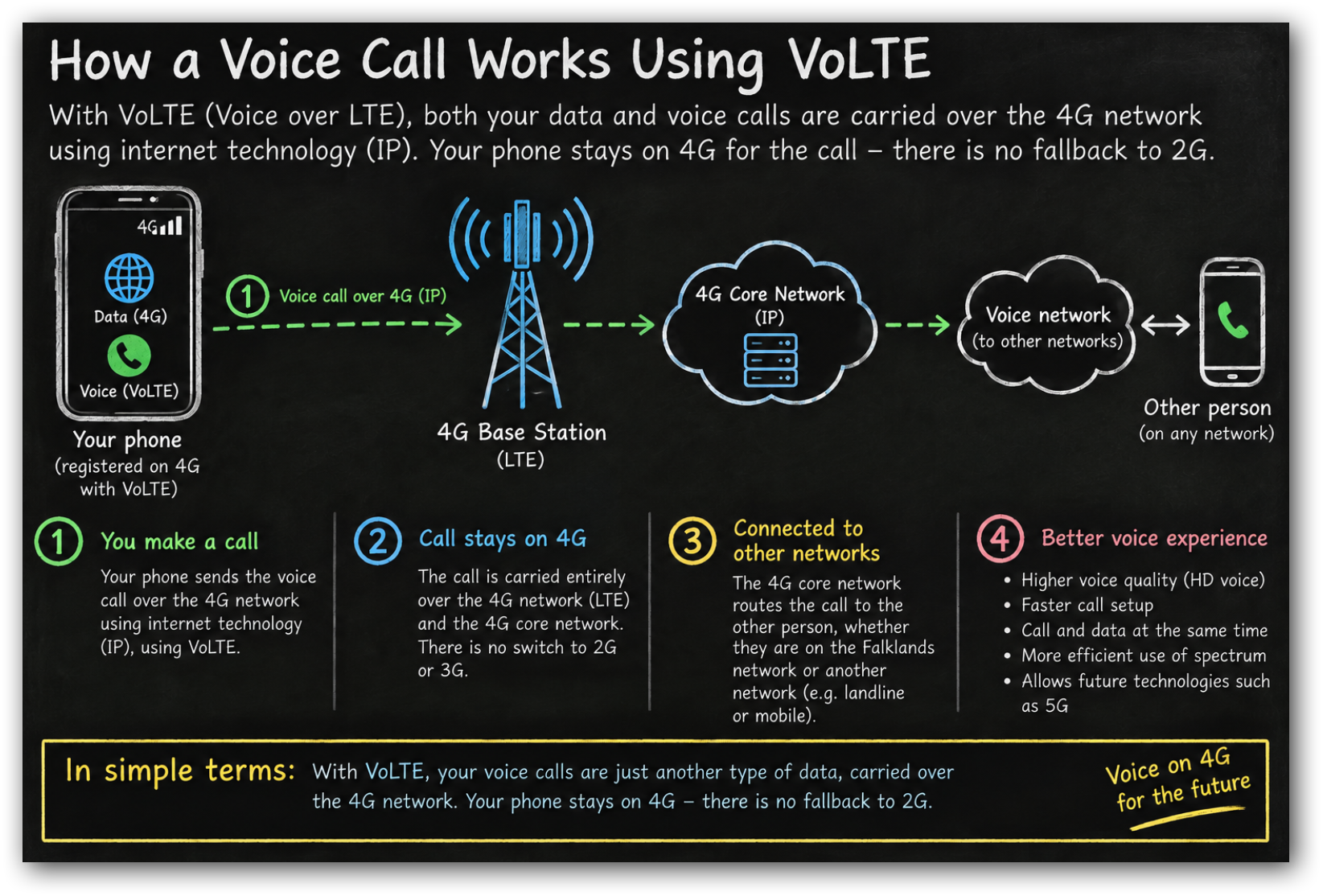
Moving conventional voice from legacy, end-of-life 2G to 4G Voice over LTE (VoLTE) would require further extensive network investment. Another important complication is coverage. With the network as it exists today, moving voice to VoLTE would provide less geographical coverage than the existing 2G voice service, potentially creating gaps in areas currently served by 2G. This is because, under the present network configuration, 2G provides a greater geographical voice footprint than 4G.
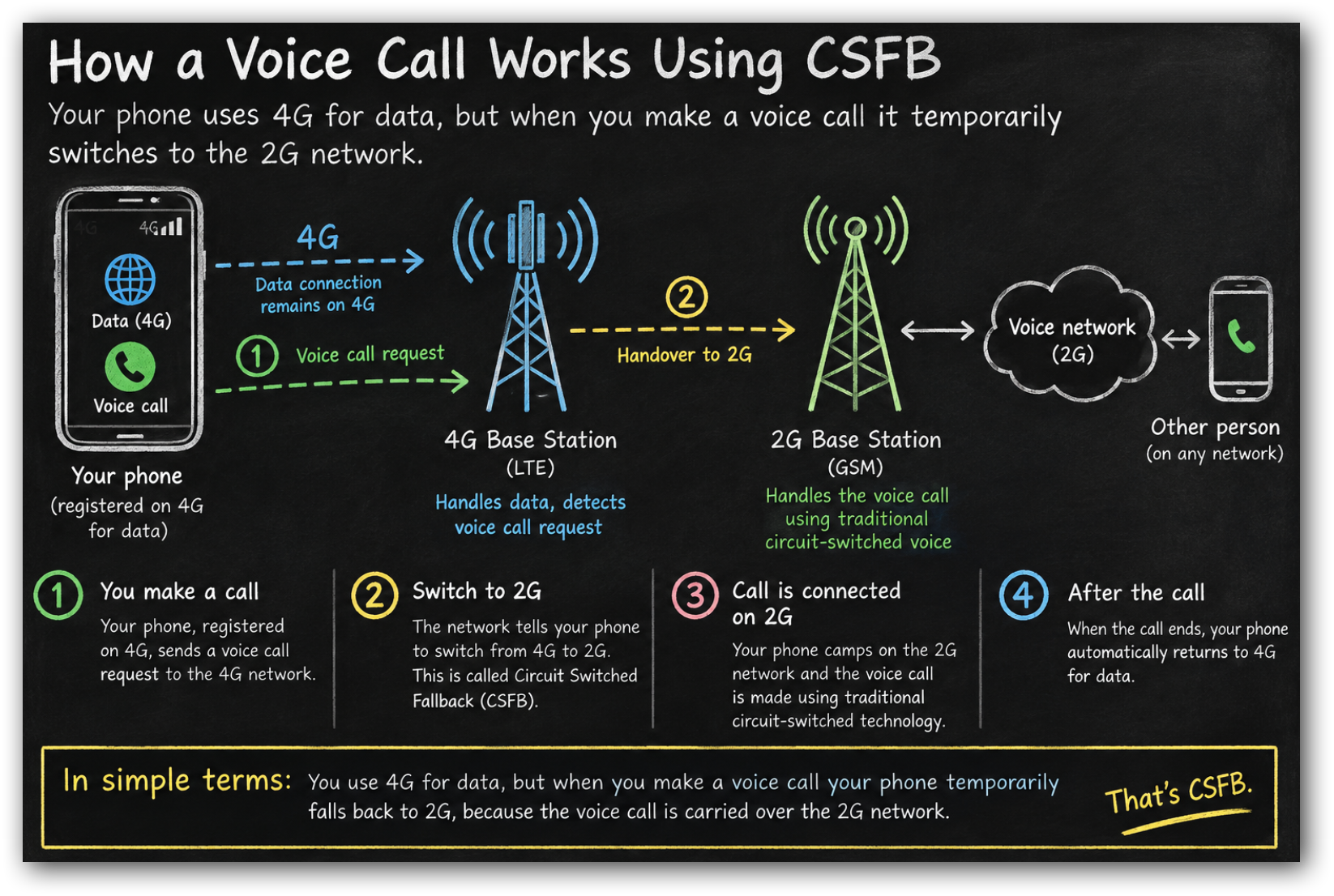
VoLTE could also improve call reliability and user experience where 4G coverage is adequate. With Sure’s 2G CSFB architecture, every voice call requires the handset to leave 4G and establish the call on 2G, adding extra signalling, call-setup delays, and another potential point of failure. This is particularly relevant in Camp, where reliable call set-up has itself been a noticeable issue. With VoLTE, the call remains on 4G, eliminating that fallback process and normally providing faster call set-up and improved voice quality.
Taken together, an important question emerges: if the mobile network is becoming increasingly important infrastructure, what is the longer-term plan to reduce and eventually replace its dependence on 2G for voice?
What Was Installed in 2018?
In May 2019, I wrote two fairly technical OpenFalklands posts looking “under the bonnet” of the new network, post 1 and post 2. In those posts, the subcontractor company responsible for the deployment, Star Solutions, provided a useful description of what had been installed. The network combined 2G and 4G base stations, using something called Circuit Switched Fallback (CSFB) for voice calls.
In simple terms, a phone would use the 4G network for data and Internet access, but when somebody made a conventional telephone call, it fell back onto the 2G network for voice. There was nothing particularly extraordinary about that in 2018. Mobile operators used CSFB as an interim way to introduce LTE while retaining existing 2G or 3G voice networks. It also provided a relatively low-cost way to introduce 4G without replacing the existing voice infrastructure.
The important word, however, is interim. The longer-term migration path was towards carrying voice directly over LTE using VoLTE, eventually allowing the older 2G network to be retired. At the end of my 2019 article, I asked when Falkland Islanders might finally be able to make HD (high-definition) voice calls over their 4G phones.
Seven years later, the Falklands mobile network apparently still relies on the same basic 2G fallback arrangement for voice. Whatever improvements have been made in the intervening years, the fundamental migration from 2G-dependent voice to a VoLTE-based service has not taken place. What was reasonably regarded as an interim solution when 4G was introduced in the Islands has, seven years later, effectively become the continuing solution.
What Does That Mean for Investment?
This is not an argument that the original network was wrongly designed, nor is it an argument against the investment now being made at Goose Green or other sites. Improved coverage is clearly welcome.
Nor does it mean that switching off 2G today would necessarily be sensible. In the Falklands, particularly in Camp, the greater geographical coverage provided by 2G may make retaining it for voice entirely justified for now. That argument is much less persuasive in Stanley, where providing comprehensive 4G coverage should present a very different and simpler challenge from covering the vast areas of Camp.
The particular Falklands problem is therefore not simply introducing VoLTE, but ensuring that 4G can provide adequate replacement coverage. The important question is not why 2G is still operating today, but whether current investment is progressively making an eventual migration possible.
Modern mobile base-station equipment can often support both 2G and 4G from the same hardware, so continuing to provide 2G voice does not necessarily mean retaining old 2G equipment. The key question is whether the new equipment being installed can support both today’s 2G service and an eventual migration to VoLTE, or whether that transition would require further replacement or upgrades. Introducing VoLTE would also require significant changes to the mobile core network so that conventional telephone calls could be carried directly over 4G, together with the necessary changes to supporting operational and billing systems.
2G itself is not therefore the problem. It remains useful where 4 G coverage cannot yet be replicated economically. The issue is whether a migration path is planned and whether today’s investment is taking the network along it.
The Bigger Question
There is a curious symmetry here. In 2019, shortly after the Falklands 4G network was introduced, I described its reliance upon legacy, end-of-life 2G for voice and asked when Islanders might eventually receive voice services directly over 4G. Seven years later, that transition has still not happened.
None of this suggests that 2G should simply be switched off. In the Falklands, retaining its greater voice coverage may be entirely sensible until 4G can provide an adequate replacement. The question is what happens in the meantime.
How long is 2G expected to remain operational? Is today’s investment progressively closing the 4G coverage gap? What further investment will ultimately be required before mobile voice no longer needs to depend on 2G?
That leads to the bigger question: What is the planned evolution of the Falklands mobile network over the next ten years, and is today’s investment taking it there? And who will pay for it?
With FIG now shaping the telecommunications arrangements that will follow the current exclusive licence, this seems a particularly good time to answer it.

Addendum 1:
A comprehensive report – A Generational Shift: international lessons from 2G network sunsetting. This Plum Consulting study examines lessons that may be learnt from 2G network switch-off in other countries, and the regulatory decisions behind it. It looks at the 2G sunsetting process in a number of countries, both where it has already occurred and where it has been delayed.
Addendum 2: a quick history of digital mobile technologies.
2G (early 1990s): The first digital standard (GSM, launched 1991 in Finland, the same network the Falklands still relies on for voice today). Digital voice was clearer and more secure, and this generation introduced SMS text messaging almost as an afterthought; it became one of the most popular features ever added to a phone. Basic data speeds only, enough for text, not much else.
3G (early 2000s): The generation that made mobile internet genuinely usable for the first time: web browsing, email, early video calling, basic streaming. Speeds were modest by today’s standards (a few hundred kbit/s to a few Mbit/s), but it’s what made the first iPhone (2007) a genuinely useful internet device rather than just a phone.
4G / LTE (from around 2009, mainstream by early-to-mid 2010s): A big jump, built from the ground up as a data network rather than a voice network with data bolted on. Speeds of tens to hundreds of Mbit/s made streaming video, app-based services, and mobile broadband properly practical. 4G was designed primarily for data, so many networks (including the Falklands’, installed in 2018) initially still handed voice calls back to the older 2G network as an interim measure, with VoLTE (carrying voice natively over 4G) meant to follow later.
5G (from around 2019 onwards): Three things at once: much higher speeds and capacity for dense urban areas, much lower latency (important for things like remote surgery, industrial automation, gaming), and the ability to support huge numbers of connected devices at once (the “internet of things”). Genuinely transformative in dense cities; 5G is far less relevant to a small, geographically dispersed population like the Falklands.
Chris Gare, OpenFalklands, September 2026, copyright OpenFalklands